
For most of the past decade, electronic ink meant one thing: the e-reader. Say the words and people picture a Kindle, a lightweight slab of gray-on-gray text that felt like paper and sipped so little power it could run for weeks. It was a beloved but narrow product, a single category that the technology seemed destined never to leave. That assumption is now outdated. Electronic ink has quietly outgrown the e-reader and spread into a surprising range of places, and the reason it is spreading says as much about us as it does about the screens themselves.
The most interesting force behind this expansion is not a technical breakthrough at all. It is fatigue. People spend an enormous share of their waking lives staring at glowing rectangles, well over seven hours a day for the average person, and the consequences are showing up everywhere: tired eyes, disrupted sleep, and a fractured, jittery kind of attention. Electronic ink offers a genuine alternative because it works in the opposite way to a conventional screen. Instead of blasting light directly at your eyes, an e-paper display reflects the ambient light in the room, exactly as a printed page does. There is no backlight to strain against and no flicker. For a growing number of people, that difference is worth chasing, and manufacturers have noticed.
To understand why e-ink can suddenly go places it never could before, it helps to know what changed inside the technology. Three quiet improvements did most of the work. First, speed. Older e-paper panels refreshed sluggishly, which was fine for turning the page of a novel but hopeless for anything that moved. Newer high-end displays refresh many times faster, making scrolling and basic motion practical for the first time. Second, color. For years, color e-paper was a gimmick, washed out and dim. The latest systems use more sophisticated arrangements of colored particles to render millions of reasonably accurate hues, enough for charts, presentations, and web pages. Third, size. The technology broke free of the six-inch reader format and now appears at thirteen inches, thirty-two inches, seventy-five inches, and larger still, all the way up to panels big enough to wrap the body of a concept car.
With those constraints loosened, electronic ink has fanned out into a whole ecosystem of devices. The most visible frontier is signage. Walk through a modern store and the price tags on the shelves are increasingly tiny e-paper labels, updated wirelessly from a central system, that hold their text without drawing power. Larger e-paper panels are replacing printed posters in shops, transit stations, and offices, delivering always-on information while consuming a fraction of the electricity an LCD screen would burn. Because the display only uses energy when the image changes, a sign can show the same content for days on a single charge, which makes it possible to place displays where running permanent power cables was never practical.
Beyond signage, the technology has crept into a scattering of consumer devices that would have seemed unlikely a few years ago. There are e-ink smartphones, still a niche but with a devoted following among people who want a calmer, less addictive handset that lasts for days between charges. There are digital art frames that display a rotating gallery of images with the matte, non-glowing quality of a real print. There are dedicated writing machines, distraction-free typewriters built around an e-paper screen for people who want to write without the bottomless temptations of a normal computer. There are smartwatches, weather stations, and industrial panels, all drawn to the same combination of low power draw and effortless readability.
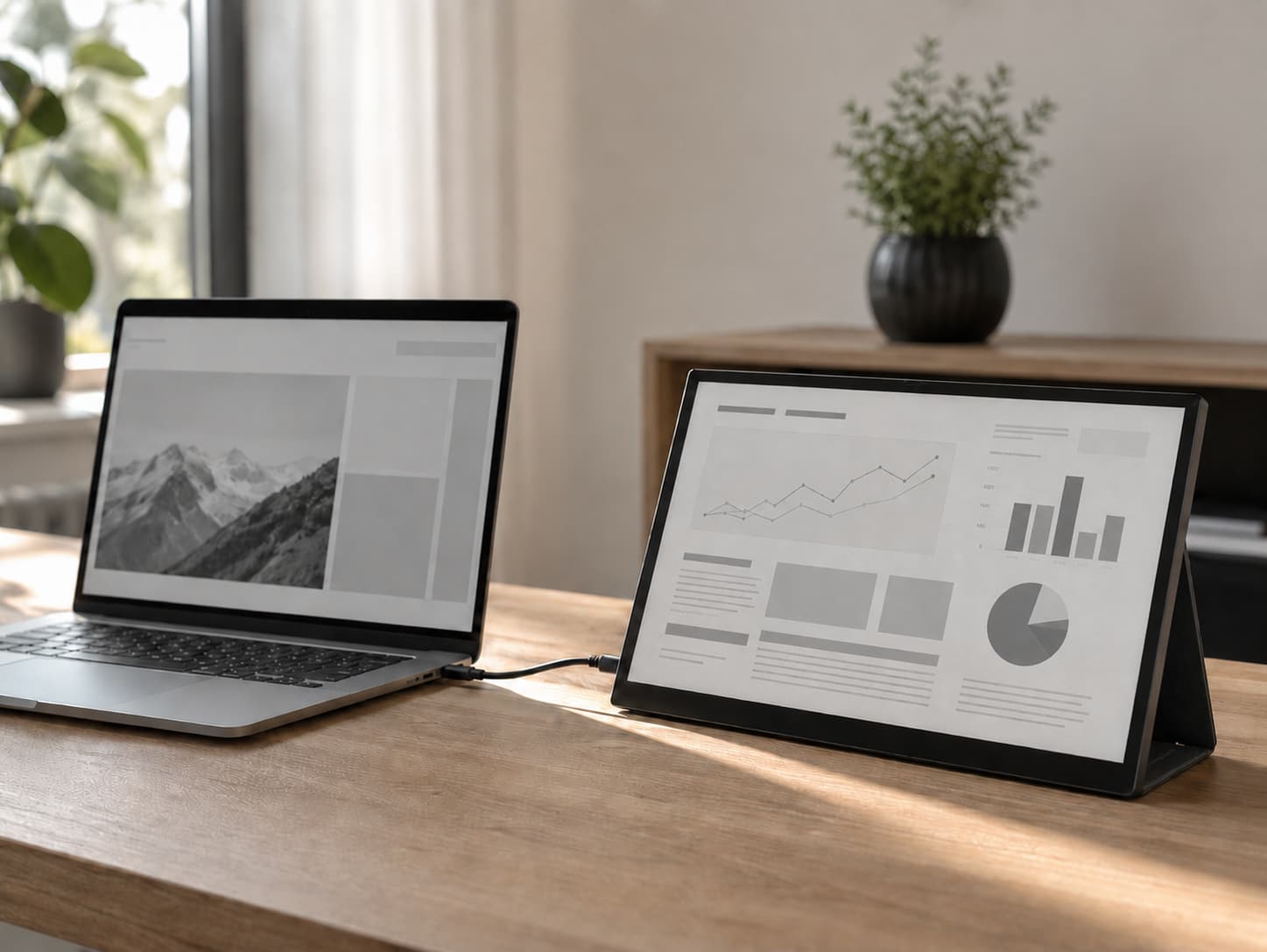
One of the most practical new arrivals is the portable e-ink monitor, a second screen that connects to a laptop or phone over a single cable and gives you a paper-like surface to work on. For writers, students, and anyone who spends long hours reading documents or drafting text, these monitors have moved from curiosity to genuinely useful tool. They let a person do the bulk of their reading and writing on a gentle reflective screen while keeping a normal display nearby for everything else. It is a telling example of how e-ink is positioning itself not as a replacement for your main screen but as a healthier companion to it.
That distinction is the key to understanding where this is all heading, and it is important to be honest about the limits. Electronic ink is not going to replace the screen on your phone, the television in your living room, or the monitor you play games on. Despite the faster refresh rates, it still cannot handle smooth video, fast motion, or the vivid color accuracy those tasks demand, and scrolling can still leave faint ghost images behind. E-ink has finally settled comfortably behind a clear line. It will not compete with OLED for anything that moves quickly or needs to dazzle. Instead it is claiming every surface that should simply display information without shouting for attention: the printed sign, the power-hungry secondary monitor, the label, the frame, the quiet reading screen.
Seen that way, the growth of e-ink is less a story about a gadget and more a story about restraint, both in the technology and in the people adopting it. In a world of screens engineered to grab and hold our eyes with brightness and motion, electronic paper offers the opposite proposition: a surface that shows what you need, uses almost no power, rests easy on the eyes, and then gets out of the way. The e-reader was only ever the first chapter. As the panels grow larger, faster, and more colorful, the technology is spreading into the fabric of everyday environments, and its greatest strength turns out to be the very thing that once looked like a weakness. It was never trying to demand your attention. It was trying to earn a little peace.