
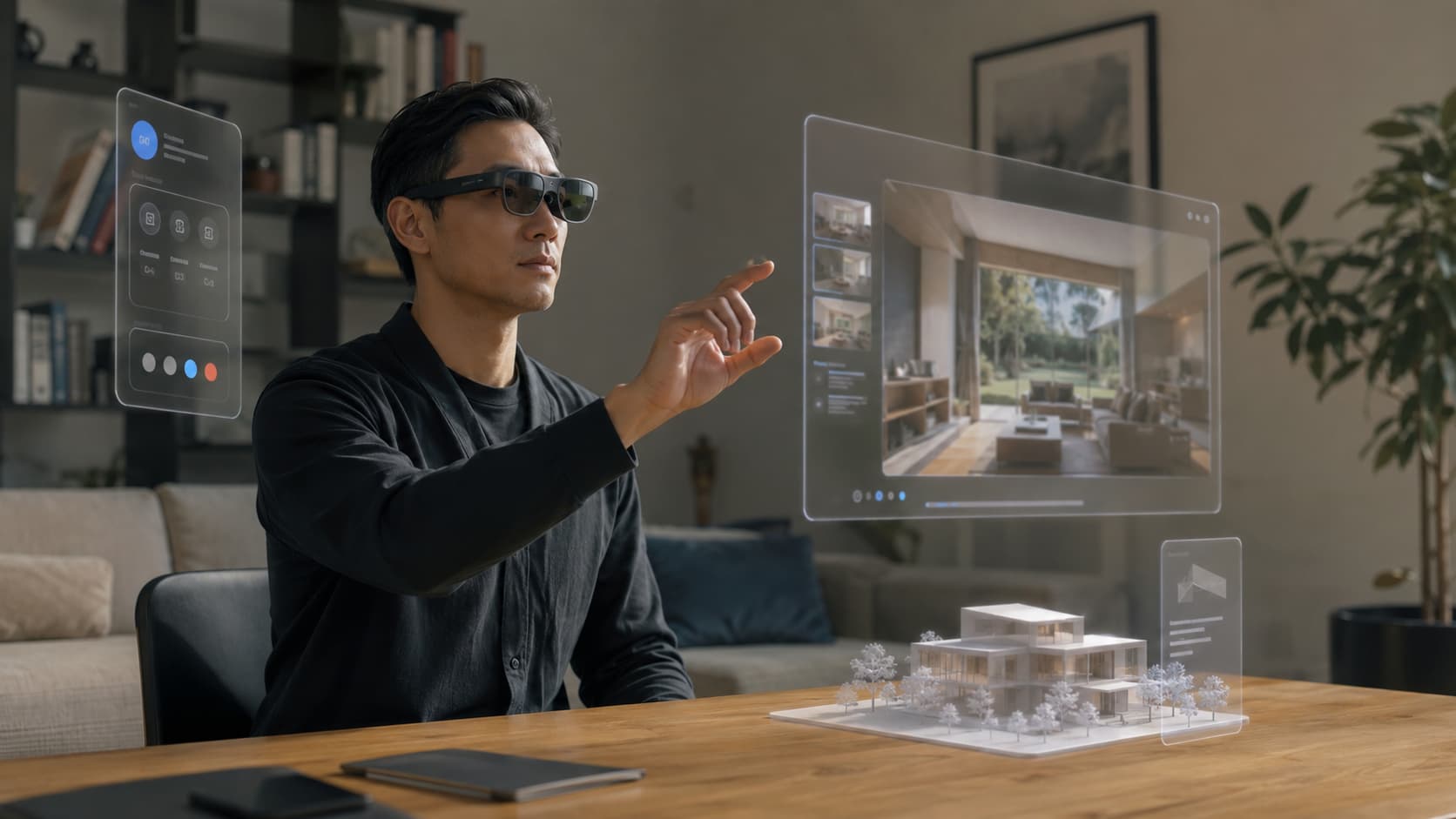
For as long as there have been digital interfaces, they have lived inside a rectangle. The screen, whether on a desktop monitor, a laptop, or a phone, is a flat plane with clear edges, and every convention of modern design grew up inside that frame. Windows, menus, buttons, scroll bars, all of it assumes a bounded two-dimensional surface that the user looks at from a fixed distance. Now a new class of devices is dissolving that frame entirely. With the arrival of capable augmented and virtual reality headsets and lightweight smart glasses, interfaces are stepping off the screen and into the space around us, and designers are discovering that almost everything they knew has to be rethought from the ground up.
This new discipline is called spatial design, and its premise is simple to state but profound in its consequences. Instead of arranging elements on a flat plane, the designer arranges them in three-dimensional space that surrounds the user. A control panel might float to your left, a video might hang on the wall in front of you, a set of notes might sit on your real desk beside your actual coffee cup. The digital content is registered to the physical world or to a virtual environment, and it occupies real volume with real position, depth, and scale. The user does not look at the interface so much as stand inside it.
The shift becomes clearer when you consider how people move through such an environment. Modern headsets track the user with what engineers call six degrees of freedom, meaning the system knows not only which way the head is turned but where the whole body moves through space. Within such an interface, a person can walk around a virtual object, lean in to inspect it, step back to see it whole, or reach out and turn it over. This is a world away from the point-and-click vocabulary of the desktop, where interaction was reduced to moving a cursor across a fixed surface. Physical freedom of this kind has been shown to help people build more accurate mental maps of a space, which is one reason spatial interfaces can feel so intuitive once the initial strangeness wears off.
Because there is no cursor and often no controller, the fundamental questions of interaction have to be answered anew. How does a user point at something floating in the air? How do they select it, move it, or dismiss it? The answers that have emerged center on the body itself. The direction of a person’s gaze becomes a way of aiming, so that simply looking at an element can highlight it. The hands, tracked in open space, become the primary tool, letting users pinch, grab, and push virtual objects with bare fingers as if they were physical things. Voice often joins in as a third channel. Together, gaze, gesture, and speech replace the mouse and keyboard, and designing for them means thinking about ergonomics and human comfort far more than pixel placement.
Depth, the dimension that flat design never had to worry about, becomes one of the most powerful tools in the spatial designer’s kit and one of the most dangerous. Placing an element closer or farther from the user creates hierarchy and focus in a way that size and color did on the old screen, but it also introduces new problems. Content placed too close can strain the eyes and feel oppressive. Objects scattered at many different distances force the eyes to refocus constantly, which quickly becomes tiring. Text, in particular, behaves unpredictably in three dimensions, and legibility that was trivial on a monitor now depends on distance, angle, lighting, and the busy real-world background showing through behind it. A great deal of spatial design turns out to be the disciplined restraint of not filling the user’s whole field of view just because you finally can.
Comfort, in fact, is the quiet governing principle of the entire field. On a screen, a badly arranged layout is merely annoying. In a spatial interface worn on the face, poor choices can cause real physical discomfort, from eye fatigue to neck strain to a disorienting sense of motion sickness. Designers have to respect the natural resting position of the head and eyes, keep important content within a comfortable cone of vision, and avoid forcing people to make large or repeated physical movements. The interface has to earn its place in the user’s body, not just on their screen, and that raises the stakes of every decision.
There is also the matter of the real world bleeding through. In augmented reality, the digital layer is superimposed on the actual room, which means the designer does not control the background at all. A menu that looks crisp against a blank canvas may become unreadable against a cluttered bookshelf or a sunlit window. Spatial design therefore has to be robust and adaptive, using techniques like subtle shadows, contrast panels, and dynamic positioning so that virtual elements remain clear no matter what physical chaos lies behind them. The environment becomes a collaborator the designer can influence but never fully command.
All of this makes spatial design one of the most genuinely new frontiers in the field, a rare moment when the accumulated conventions of decades no longer simply apply. Designers working in this space are effectively writing the rulebook as they go, borrowing what they can from architecture, theater, and industrial design as much as from traditional screen work. The core insight is that they are no longer decorating a surface but shaping an experience that a person inhabits with their whole body. As glasses grow lighter and headsets more common, the interface is quietly leaving the rectangle behind, and learning to live in the same three dimensions we do.